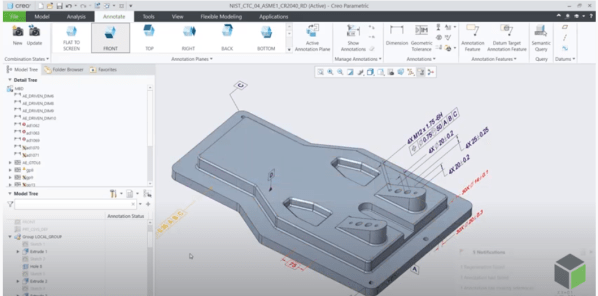
With Creo 8.0, text symbol pallet is easily accessible for datum feature symbol (DFS) annotations. This allows you to add standard text symbols to a datum feature symbol annotations UI: Annotate -> Datum Feature Symbol ->place DFS -> Select DFS-> activate text field ->Symbols ptccreo.punditas.com
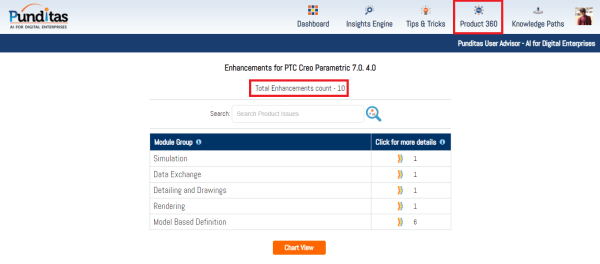
Punditas AI Advisor now supports Creo 7.0.4.0
PTC released Creo 7.0.4.0 recently. Punditas AI Advisor now supports this latest version of Creo 7.0.4.0 . Punditas AI allows users to learn more about “How”, What” and “Why” of these enhancements through Product 360 module. The picture below shows the Module groups and the corresponding enhancements added within each group. To try this out,... Continue Reading →
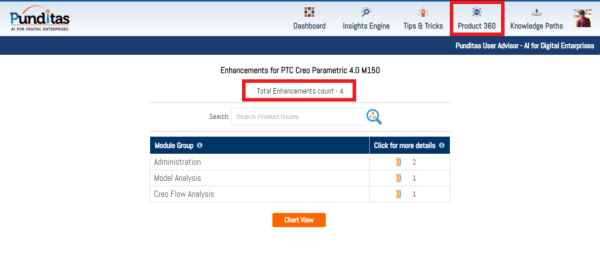
Punditas AI Advisor now supports Creo 4.0 M150
PTC released Creo 4.0 M150 recently. Punditas AI Advisor now supports this latest version of Creo 4.0 M150. Punditas AI allows users to learn more about “How”, What” and “Why” of these enhancements through Product 360 module. The picture below shows the Module groups and the corresponding enhancements added within each group. To try this... Continue Reading →
Punditas AI Advisor now supports Creo 8.0.0.0
PTC released Creo 8.0.0.0 recently. Punditas AI Advisor now supports this latest version of Creo 8.0.0.0 . Punditas AI allows users to learn more about “How”, What” and “Why” of these enhancements through Product 360 module. The picture below shows the Module groups and the corresponding enhancements added within each group. To try this out,... Continue Reading →
Did you know that Creo now uses absolute accuracy by default?
Starting with Creo 7.0, Creo Parametric uses absolute accuracy instead of relative accuracy. The default accuracy values are 0.00039 inches and .01 millimeters. The template files are also adjusted so that new empty models are created by default with absolute accuracy. Template files use the following naming schemes: Absolute accuracy uses the new template files by default.... Continue Reading →
Did you know that you can exclude child annotations based on the parent status in Creo 6.0?
Creo Parametric 6.0 added a very useful feature to start allowing us to exclude annotations from our design and graphics when their parent feature is no longer available. Child annotations can be excluded when the parent feature is not available in the following situations 1. Excluded by family table 2. Excluded by simplified representation or Family... Continue Reading →
Delaunay triangulation, Stochastic lattices and Additive Manufacturing in Creo
PTC introduced Stochastic lattices (random lattices) in Creo Parametric 6.0. This first implementation of the stochastic lattices used Voronoi diagram algorithm. Voronoi is a common algorithm when you want a lattice to conform to bionic shapes. However, starting with Creo Parametric 7.0.0.0, Delaunay triangulation was introduced. The Delaunay triangulation generates a set of triangles to use... Continue Reading →
Did you know that you can pause while rendering in Creo?
The rendering process in Creo Render Studio can heavily use computer resources and block other applications from functioning efficiently. You can now pause rendering to free up system resources starting with Creo 7.0 You no longer need to cancel your rendering and then restart it when you return to Render Studio. You can pause your... Continue Reading →
Did you know that Mirror tool in Creo Sketcher is enhanced?
Starting with Creo 7.0 release, Mirror tool in Sketcher has been made easier. To mirror, select the sketched entities to mirror and select reference. Allowed entities for mirror reference are horizontal and vertical sketch reference lines, and other straight geometric entities, such as model edges, projected geometry, curves, standard and construction sketched lines and center lines.... Continue Reading →
Punditas AI Advisor now supports Creo 4.0 M140
PTC released Creo 4.0 M140 recently. Punditas AI Advisor now supports this latest version of Creo 4.0 M140. Punditas AI allows users to learn more about “How”, What” and “Why” of these enhancements through Product 360 module. The picture below shows the Module groups and the corresponding enhancements added within each group. To try this... Continue Reading →